

Why five cables on one pole costs everyone
Every ISP running its own drop down the same street pays for the same wayleave, the same closures and the same repairs. The customer pays for all of it.
· 3 min
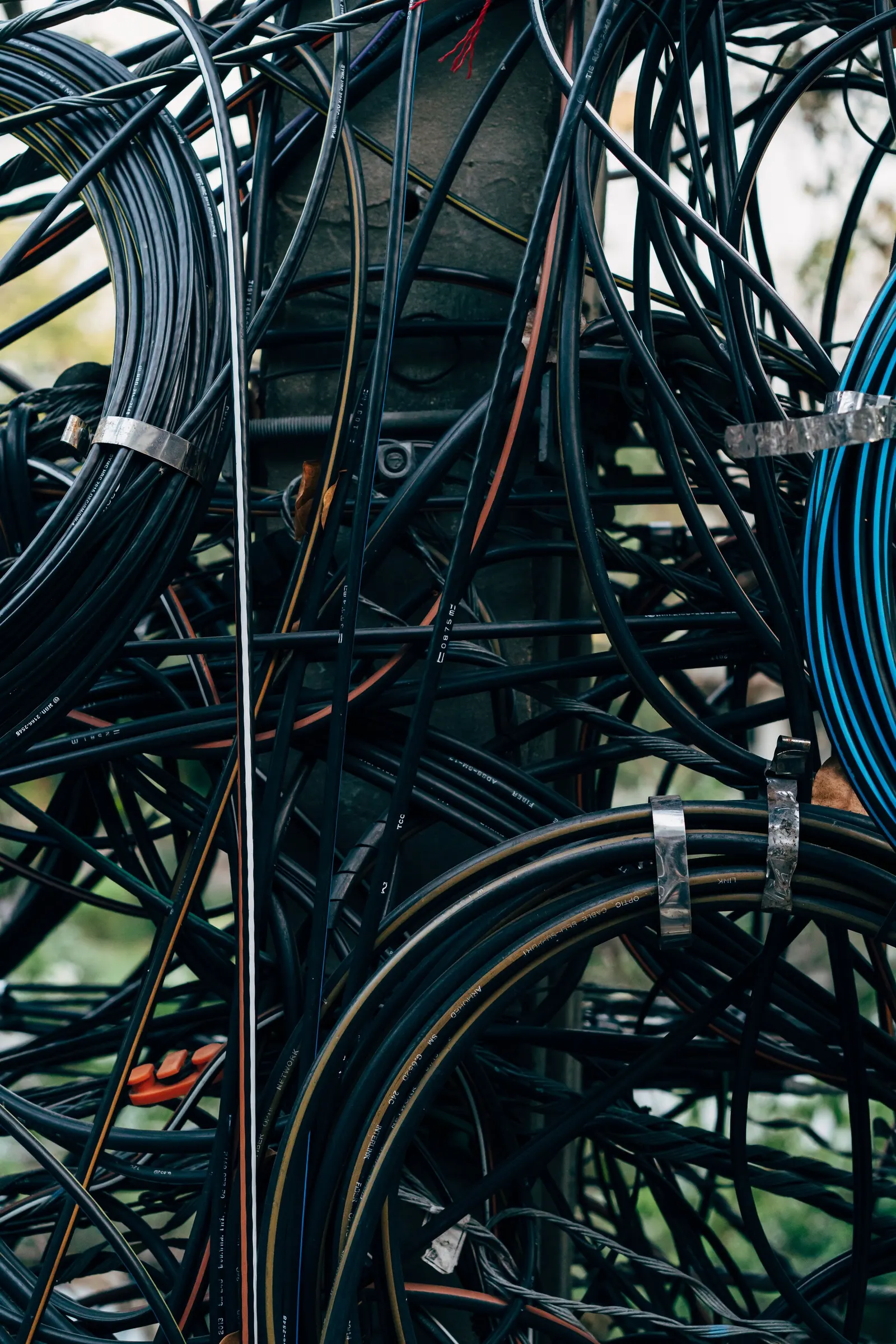
Walk down almost any estate road in Nairobi and look up. On one pole you will often count four, five, sometimes more fibre cables. Each belongs to a different ISP. Each was strung by a different crew, at a different height, with its own idea of lashing.
They all serve the same houses.
The same work, paid for five times
To put a cable on that pole, each ISP had to do the same things:
- negotiate a wayleave with the pole owner and the county;
- buy and haul its own cable;
- hang its own closures;
- send its own crew every time something breaks.
None of that work is different from one ISP to the next. The street is the same. The poles are the same. The homes are the same. Five companies paid for five copies of a network the street only needed once.
That cost does not disappear. It goes into the monthly price of a home connection.
Each cable makes the others worse
Crowded poles are harder to work on. A technician fixing one cable has to move three others to reach it. Slack loops tangle. Closures end up hung wherever there is space, not where they belong. When a truck snags a low cable, it often takes the neighbours with it.
So one ISP's outage becomes four ISPs' outage, and four crews arrive to fix it. Each charges its own time to its own customers.
The pole owner pays too
Power utilities and road authorities did not build their poles for fibre. Every extra cable adds load and clearance problems, and makes their own maintenance harder. That is why pole access gets slower and more expensive to negotiate. The owner is pricing in the mess.
What one cable looks like instead
On an open access street, one network is built once. It has:
- one cable on the pole at the right height;
- one closure at each joint, hung and recorded properly;
- one drop into each home.
Any provider can plug in at the network edge and sell its own service under its own brand. The ISPs compete on price and support, not on who can string the most cable.
The savings are not subtle. The wayleave is negotiated once. The crew visits once. When there is a fault, one record shows which closure to open, and every ISP's customers come back at the same time.
Who benefits
The ISP reaches a street without building it. The pole owner deals with one tenant built to a standard. The customer pays for one network instead of five.
This is what LitSpan Africa is for: one party owns and lights the fibre, and many providers sell over it. {/* source: litspan.com/ */} It is not a new idea. It is the way water and power are built. Fibre is overdue.